Deal Killers, Contract Assassins, Home Inspectors! Call them what you will, but the most important thing you can know is WHO to call. But how do we know who call, and how do we judge their expertise?
Home inspectors are quite simply the eyes and ears of the home being examined. They are the objective voice of the home. The mantra of the home inspectors should be “if the home could speak, what would it say”. It is critical that the inspector can speak in a manner that makes understanding simple for the homebuyer, yet has the depth of technical language to detail repairs using terminology common to the trades.
Making that right choice of which home inspector is in many ways more difficult than choosing the home. A clear and critical approach to selecting an inspector is essential to being happy over time with the home selected.
My Friend in Construction It seems that everyone knows someone who “works in construction”, and from that relationship comes the common desire by some buyers to save the professional inspection fee by having the friend or family member perform the inspection.
At first blush, this seems like a perfect solution. The friend or family member is a known and trusted person. There is no doubt in the mind of the buyer that the loyalty and intentions of this person are above reproach. And then of course, there is the issue of saving the inspection fee.
These attributes of the friend are important. Ideally, all but the expense issue would be traits found in any professional home inspector. The difficulty arises in three principal areas; objectivity, creditability, and inspection specific knowledge.
Let’s look first at the issue of inspection specific knowledge. While it may be that the friend is without peer in his particular area of construction, it is rare that he is able to view the home in it’s entirely – that is, as an interaction of dozens of complex and interrelated systems. The most knowledgeable of heating and air-conditioning contractors may know near to nothing about roofing.
Even more common, however, than the lack of a broad base of knowledge, is the lack of any knowledge that is useful during a home inspection.
On more than one occasion when the “friend in construction” has been asked specifically about construction experience or knowledge, it turns out that this actual experience was something other than optimal. This “experience” usually amounts to something along the lines of loading trucks at the hardware store to earn beer money during spring break back in 74′! Even with the best of intentions, this is hardly the knowledge needed to guide a friend or family member through what is most likely the largest financial decision of their life.
The Objectivity of My Desire By the very nature of friends and family members, they are not objective. They have great compassion for the buyer and likewise great fear that some harm, be that physical or financial, may come to that buyer. Making matters all the worse is the fear in the back of the head of the “friend in construction” that their experience is not truly enough to render the opinions being offered.
This takes the situation down the path to an even less desirable situation. We have a nervous or anxious buyer being given advice by a now nervous and anxious person who is operating well outside their area of expertise. However, they are now reluctant to concede that they are lost and scared. This is not good for anyone in the transaction – buyer, seller, or agents!
Trust and Credibility Moving on, we come to the issue of credibility. I’ve observed thousands of transactions, and it seems to me that sellers are a distrusting lot. Or rather, they certainly are when it comes to the issue of imperfections in their homes.
What happens if, by some stroke of good fortune, the “friend in construction” actually performs the home inspection in a superior manner, and actually discovers all of the homes flaws in a clear and concise way? It is still probable that the seller will doubt the results are fair and objective due to the relationship between buyer and “inspector”.
This inherent distrust most always results in a professional inspector being called in to confirm or deny the observations of the “friend”. Who pays the bill for this additional involvement and what to do with conflicting observations only adds another layer of pain and confusion on a transaction that is already hemorrhaging to death.
Who to Hire? Keep life simple! Always hire professional ASHI qualified Home Inspectors. You can be sure that ASHI home inspectors adhere to a strict Code of Ethics, a well-defined Standards of Practice, and have passed the most demanding membership certification requirements in the country.
And if there is a personal connection to the home inspector, be SURE to disclose that up front to all concerned. Most people will not object to the disclosure, but let the discovery be make after the fact and the trust, as well as the transaction, may be gone forever.
Even if you aren’t handy, there are everyday situations that require a hammer, a screwdriver, a tape measure, or a saw.
Jennifer Hunter didn’t have a toolbox when she moved into her first Philadelphia apartment. But she soon found that, even in places with landlords and maintenance staff, one stocked with the basics was necessary.
“Every apartment required more tools ,” said Hunter. “When you have plaster walls, and need to put up shelves, you move into drill territory.
“I need a bigger toolbox now because this one is overflowing,” she said.
Although Hunter is heading into advanced territory, there are basic tools that should be in every house, whether you are a do-it-yourselfer or all thumbs.
“At least have a hammer, screwdriver, and a tape measure,” said Pam Price, spokeswoman for the PBS series Hometime. “Many manufacturers are coming up with toolboxes that fit in kitchen drawers” because the kitchen is an ideal place for tools to be easily accessible.
“It’s better to have the tools at hand where they are needed than having to run to the basement looking for them,” she said.
Building Products magazine editor Jean Dimeo polled her staff, and this what she and they came up with:
WD-40 oil
duct tape
locking pliers
a flashlight or work light
gloves
tape measure
utility knife
wire cutters
sandpaper of assorted grits
putty knife
speed square
straight edge with right angle
small level
wire
string
screws and nails in various sizes
wood glue and rags.
Although it doesn’t fit in most toolboxes, a plunger (maybe two) should be standard in every house. Keep it under the kitchen sink or in the bathroom so you can get to the blockage before it starts doing real damage. A 12-ounce hammer is ideal for banging in nails to hang pictures.
Contractor John Burke is a big fan of pry bars, and carries two or three different kinds. He also carries a small crowbar that provides the right amount of leverage for removing stubborn nails from lumber.
The tape measure he uses is 30 feet by 1 inch. Burke said he preferred the newer tape measures that lock automatically and are released by squeezing the bottom.
While he admitted that his toolbox is appropriately stocked for a professional, he said he thinks that people should have basic tools for the basic tasks that come up every day. “The two most important things in a toolbox are ear protectors for using power tools and safety glasses,” Burke said. “I won’t let my kids help me unless they are wearing safety glasses.”
Mike Mangan, who travels the country as a spokesman for Sears Craftsman tools , agrees. Although his toolbox is better stocked than those of the average homeowner or apartment dweller, Mangan said the most important advice he could offer was to spend money for quality, even if you were buying only a few essential tools .
“When you buy a 99-cent screwdriver, you get a 99-cent screwdriver,” Mangan said. He suggests a claw hammer weighing 18 to 20 ounces and a rubber mallet that at least can be used to bang a hubcap back on a wheel without denting it. And, Mangan said, “When you buy that tape measure, get one that can be read on both sides.”
Burke also recommends chalk because it is easier to remove than pencil marks, and a sea sponge, which is useful for smoothing joint compound in minor drywall repairs. The level can be a small as 9 inches, but Mangan said he thinks a 48-inch level is more useful for getting pictures straight when you hang them. Buy a set of screwdrivers with different sizes of Phillips and slotted heads, he said.
Matt Schultz, a preservationist, said he believes that the toolbox should include a corded drill with screwdriver bits because the number of small jobs around any house or apartment will pay back the investment quickly. Because most inexpensive furniture – Ikea’s, for example – needs to be assembled, Schultz suggests putting Allen wrenches of various sizes in the toolbox, too.
The popularity of computers has created a need for precision screwdrivers – both Phillips and slotted-head – to remove tiny screws that hold screen covers. These tools, once used exclusively by hobbyists, watch-repair people, and jewelers, are useful also for tightening screws that hold eyeglass frames together.
Finally, “no matter what you decide to keep in the toolbox, don’t forget a first-aid kit or Band-Aids,” Schultz recommended
Here I sit on the first workday of the year. The office is not yet open and the phone has not yet rung. I love this time of year. Nothing yet accomplished, and no mistakes yet made. It is a wonderful time to reflect on the year that was, and look ahead toward the year that is yet to be.
The idea that comes to mind is that it will be a fantastic year if we can inspect another 3000 homes and do it without a single complaint! A lofty goal indeed, but one worth working towards!
Imagine a year without a single complaint! I reason that goal is good for real estate professionals, good for me, and great for our mutual customers. Just how would we work toward a year without an unhappy customer?
First and foremost, we must always remain customer-focused. There is a very easy test of every decision we make with or on behalf of our customer. Simply ask “if I were doing this for my mother, how would I do it”? Works like a charm every time! It seems that when we have a deep personal interest in putting the best interest of another individual first, things always work out better.
Long ago I worked for a fellow who often said “want it bad, get it bad”. He was a commanding officer of a Navy squadron, not a realtor, but his point was this – sometimes we want a particular outcome so bad that we do bad things to get there. Some deals just don’t need to be done, or done in the manner that they are preceding, when not in the best interest of the customer. If we stay centered on their best interest it is likely they will end up happy with their home, happy with their real estate professional, and have a low probability of complaint. Maybe even become a referral source!
Second, we must educate our customers on how good choices are made. Using home inspection as the example, it is not enough to simply refer a particular inspector or inspection company, or, worst of all, put our head in the sand by sending them to the yellow pages. We need to be able to articulate how and why sound choices are make. Have them compare companies on the web. Even if we make specific recommendations, we owe it to ourselves and to our customers to explain the process by which we made the recommendation.
When people lack a well-articulated case for recommendations it has numerous risks. Customer confidence is reduced with an answers such as “be sure the inspector is licensed”, or my favorite from agents, “he has never killed a deal in my office”. As all should know, there is no license requirement in Florida for home inspectors (a subject for another column), and the deal killing statement is hardly customer-focused. A more compelling case might be something such as a description of our own Chris Brown, “Chris has been a state licensed contractor for over twenty years, an ASHI certified home inspector since 1997 and has performed more than 3,000 home inspections. I would recommend Chris to my mother”. Now THAT is compelling!
Lastly, it is critical to keep the customer engaged in the process. When the customer is deeply involved with every turn in the home buying journey they feel more in control. For the home inspection, this means the buyer must attend the inspection. It is interesting to study home inspection complaints. We receive about one complaint for every 500 homes inspected. That is really very few, but remember we are working toward zero! By our definition a complaint is a call from a past customer that could not be solved over the phone, but required me to revisit the home. In 9 out of 10 complaints, the customer did not attend the inspection!
By not attending the home inspection, buyers have a greatly reduced understanding of not only the inspection process, but also a reduced understanding of their home. And more bad news, if the buyer did not attend the inspection, their real estate professional probably did. Now not only are they unhappy with me, they are also unhappy with their agent!
After more than ten years and 20,000 inspections I can tell you this, the surest way to a happy customer over the long term is:
• Always put the best interest of the customer first
• Educate your customers for clear and comfortable decision making
• Participate along with the customer in every event
So far so good, the phones are ringing, the schedule is filling and to this point, a complaint free year! Let’s all work hard to keep the streak going!
When properly installed and balanced, a ceiling fan should not wobble excessively. Make sure your fan has been mounted properly; there should be an electric box or special bracing to support the fan’s weight and movement. See Figure to the right..
You may be able to stop the wobble by switching blade positions and balancing the fan (see below). Contact the manufacturer of your fan for specific instructions, and ask if a balancing kit is available.
Typical balancing instructions:
1. Check that the fan is properly installed and that the blades are securely attached.
2. Run the fan on high speed (set to downdraft) and observe the wobble. Stop the fan; switch positions of two adjacent blades. If this improves the balance of the fan, leave it as is and use balancing weights.
3. With the fan stationary, attach the manufacturer’s balancing clip on the leading edge of one blade, halfway between the outertip of the blade and the attachment bracket. (A balancing clip, available from most fan manufacturers, is a small plastic weight that firmly clips to the blade.)
4. Run the fan on high speed, set to downdraft, and observe the wobble. Stop the fan; move the clip to the next blade. Again run the fan and observe the wobble. Repeat this for all fan blades.
5. Move the clip back to the blade where you noticed the least wobble. This time, attach the clip to the leading edge of the blade near the blade bracket. Run the fan and observe the wobble. Stop the fan and move the clip outward toward the end of the blade in small increments until you find the position where the fan runs best.
6. Attach a permanent balancing weight on the blade next to the clip. (Weights are often self-stick lead strips provided by the fan manufacturer.)
7. Remove the clip and run the fan. If the wobble was not completely corrected, you may be able to further improve the balance by repeating the above steps and adding more weights.
Doorbell Problems
Don’t be afraid to try to repair the doorbell. All of its parts are low voltage—12 to 24 volts—and can’t really hurt you. However, you should not attempt to repair or replace the transformer for the unit, which will be located in the basement or near the main power panel. It converts a 110-volt supply to 12 or 24 volts.
Most often, the chime unit consists of an electromagnetic plunger that strikes a chime when activated—one sliding movement (and one chime) for the rear door and two movements for the front door’s double chime.
Some door chimes consist of a low-voltage buzzer or a vibrating hammer on a bell. Others have huge chimes and complicated parts best left to a service company.
If the doorbell thumps or hums when you press the button, you need to clean the chime and plunger.
If pressing the button doesn’t trigger any sound, the button itself is probably at fault. The doorbell button is the most common source of problems because of its exposure to weather. For a button that’s flush with the wood trim, slip a screwdriver or putty knife under the edge to pry the button out of its hole. If the button is screwed to the frame, remove the screws.
Now you can see the low-voltage wires. If they are loose or broken, this could be why the doorbell isn’t working. See Figure below.
If the wires look okay, disconnect their ends and touch them together to complete the circuit. If the doorbell rings now, you have found the problem—a bad button. You can easily replace the button with a matching button from the hardware store.
If the doorbell does not ring when you manually complete the circuit, the problem is in the chime or transformer.
Check the chime: remove the cover, and take a peek at the chime. Make sure it is level. Vacuum away any dust. You will see a round plunger that needs to move freely in the magnet surrounding it. Look for broken parts or damaged brackets.
After you have checked these items, the next step would be to use a voltmeter to analyze the transformer and wiring. This is a task you may wish to leave to a professional because it involves working with 110-volt power.
Or, for about $20, you can buy a new battery-operated chime/button set that needs no wires. The button is mounted anywhere within 100 feet of the chime. This is a great option when wires are damaged.
Removing Broken Light Bulbs
Sometimes, especially on exterior light fixtures, the glass bulb breaks away from the metal base. There is no best way to remove the base from the fixture, but here are several options.
Before replacing an exterior light, purchase a higher quality bulb with a brass-plated or copper-plated base that will not rust. You could coat the threads with a special dielectric grease available at automotive stores. Dry lubricant, Permatex Anti-Seize, and Vaseline will also work.
To remove the broken base, first make sure the power is off. Wear eye protection. Protect the immediate area from broken glass that may remain on the base. I like to use a needle nose pliers to grab the metal rim of the bulb and twist it. You can also jam the nose of the pliers into the base of the bulb to get a grip. Sometimes opening the pliers inside the metal threads will give you a grip.
If all else fails, use the needle nose pliers to collapse the metal threads until you can remove them.
Folks have phoned my radio show with the following suggestions for removal:
Use your fingers, protected by heavy gloves.
Use a fuse puller the same way I use a needle nose pliers.
Jam into the broken base and turn with: -a large cork -a wooden ruler -a wad of white bread (perhaps you need some really heavy Italian bread – a potato -a trimmed paint-stirring stick
Patio Screen Door Sticks and Rubs
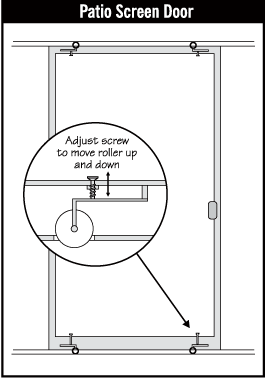
Almost every sliding patio screen door in the world sticks, because few homeowners know they can adjust the rollers that run in the track. You still need to keep the track clean, but adjusting the rollers is the key.
Look at the base of the door; you will see two small Phillips screw heads. They will be above the frame or in the side of the door, near the bottom. Tightening these screws lowers the rollers and lifts the door so the door rolls on the rollers without rubbing the frame. See Figure to the right..
Most doors have a similar roller adjustment for the top rollers. If the door is tight or bound in the frame, loosen these top screws to allow the door to be raised when lowering rollers and screws. Don’t adjust the door to the point that it’s squeezed between the top and bottom frame.
When you adjust the rollers, clean the track. Then spray a light lubricant on the frame and track.
Bathroom Paint and Mildew Problems
If your bathroom has problems with moisture, mildew and peeling paint, an exhaust fan is the best solution. You could have a fan installed in the ceiling or, if that’s not practical, perhaps you can put a fan directly in an exterior wall.
Reduce bathroom moisture problems by wiping down wet surfaces after a shower and removing wet towels. Keep the bathroom door open after a shower. Consider using a small fan to circulate air into the hall.
You can also use a special paint that resists mildew and peeling. First, kill existing mildew with laundry bleach and water. Scrape away any loose paint, and sand the surfaces smooth. Spackle as needed. Then paint with Zinsser brand Perma-White Bathroom Wall and Ceiling Paint. This is a self-priming paint, so apply two coats. See Figure to the left.
Zinsser Perma-White is a white semi-gloss paint that can also be tinted. I have used it for several years with great success. It is guaranteed to resist mildew and peeling.
Proper Venting of a Fireplace
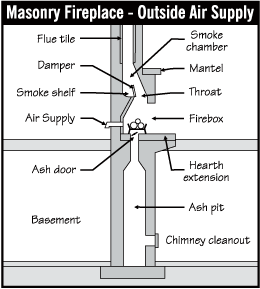
The draft problem with most fireplaces in tightly-built homes is that the fire lacks sufficient air for combustion unless a window is open. Sometimes this produces smoke indoors. Fireplaces in older homes didn’t have this problem because leaks around windows, doors and framing provided plenty of air for combustion.
A fireplace with an inadequate air supply can be dangerous. As a fire is starting or going out, it may back up dangerous carbon monoxide into your home. A fire with a strong draft can also interfere with the natural venting of a gas-fired water heater or furnace, causing a backdraft of combustion fumes into the home. Any gas-burning appliance vented by gravity up a chimney can have such a problem.
One good solution is to install small fresh-air vents that bring outside air directly in the firebox. A qualified brickmason, fireplace contractor, or chimney sweep must install such a system; it is definitely not a do-it-yourself project. The vent must penetrate an outside wall and the side or front of the fireplace. The vent may also need to be combined with fireplace doors. See Figure below.
Remember that most natural fireplaces are heat losers when operated in cold weather. Most of the heat goes up the chimney. Fireplaces do work well at removing excessive moisture levels in the winter because they draw lots of air into your home for ventilation (provided a window is open!)
Gutter Leak—a Quick Patch
For quick repair of small holes in the rain gutters, try gutter repair or flashing tape. It’s available in most hardware stores and is manufactured by several companies. This thick aluminum foil tape uses a mastic-type adhesive that’s almost like thick tar. The tape comes in short rolls either 2″or 3″ wide and costs just a few dollars.
To repair the gutter, clean away debris with a wire brush. Wash the area. Once it’s dry, apply the tape, rubbing it well into the hole. The aluminum facing on the back side allows you to rub the tape securely onto the gutter. The foil also protects the patch from sunlight. The adhesive of the tape is thick enough to fill small holes and seams. This repair can easily last several years.
Black Stuff Growing on the Roof
If your roof has light-colored shingles, you may see black streaks on them, especially on the north side. The problem is caused by mildew or fungus growth. There is less sunlight on the north side, so the roof stays damp. Mildew loves a damp surface.
The best way to prevent this algae growth is to provide sunlight and natural ventilation to dry the roof. Obviously, this is not always possible. At least keep all tree branches and leaves about 4 feet away from the roof.
Short of replacing the roof, there is no good quick fix. You could try killing the mildew with a strong solution of laundry bleach and water. Spray or brush the solution on the roof and wait until the areas turn lighter. Then rinse well. You could also use a mildew wash that is sold in paint stores for washing painted wood siding.
Several cautions about using bleach: protect yourself, the gutters, and plant materials. Spilled bleach solution can kill grass and bushes. Use eye and skin protection. Do not walk on the roof while cleaning; it will be slippery and dangerous. Work from a ladder or use other special equipment. Flush the gutters and metal flashing well to prevent damage.
I suggest you hire a professional roofer for the cleaning. You can also purchase a product called Shingle Shield, which consists of zinc strips that are placed under the shingles near the peak of the roof. The zinc reacts with rainwater to produce a chemical that prevents the growth of fungus and mildew. Again, consult a professional roofer. Although the product inhibits the growth of new algae, it may not remove existing algae.
If you ever plan to replace the roof or build a new house, keep in mind that several shingle manufacturers offer shingles with a built-in mildew-resistant chemical.
Peeling Varnish on Front Door
Many homes feature a beautiful wood front door that is stained and varnished. In time, though, the varnish begins flaking and peeling, especially if there’s no storm door.
Sunlight is the culprit. Ultraviolet (UV) rays attack the cellular structure of the wood under the varnish, giving it a “sunburn.” Varnish can’t stick to damaged wood. UV rays also damage the clear finish.
The best solution is to paint the door. Paint has coloring pigment that blocks UV rays and protects the wood. But if you really like that stained and varnished look, it requires a little work.
First you must sand, scrape or strip the damaged finish. Where the finish is in good condition, you must sand and roughen the surface. If the color of the wood has changed, you will need to stain the door before varnishing.
How far you go with the refinishing depends on the condition of the door. If more than 25% of the finish is damaged, your best bet is to chemically strip the door and start with bare wood.
For a final clear finish, look for a UV-resistant varnish (often called spar varnish or marine finish). This finish is expensive and may only be available in a gloss formula. Follow the specific instructions for your varnish, and don’t forget to finish all six areas of the door (front, back, top, bottom and sides).
A final option would be to install a storm door to protect the wood door. There are attractive storm doors available that are mostly glass so your wood door can still show through.
Opening the Garage Door During a Power Outage
Let’s say you’ve got an automatic garage door opener. It’s a great convenience, one you take for granted…until the power goes out. Now what do you do?
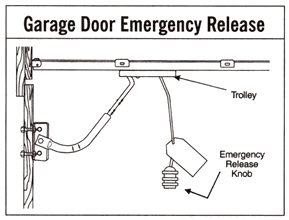
Your door opener came with an emergency release. This allows you to disconnect the door from the automatic opener unit and open the door manually. The release is a lever attached to the track and door arm connection. See Figure below.
It’s a good idea to test this emergency release before you need it, just to make sure it works properly. If you are confused by the procedure even after reading the following instructions, have someone show you how the release operates.
Start with the door closed. This is very, very important. If the springs are not adjusted properly, a door released in the up position may crash to the ground. Open the door manually. You should only need to apply a few pounds of lift, and the door should almost balance at any point as you raise and lower it. If you must use excessive force to open the door or if it closes very quickly, the balancing springs need to be adjusted.
These springs have a tremendous amount of force, so have any necessary adjustment done by a professional. Sometimes the cable and pulley mechanisms also need adjustment or replacement.
If you have a detached garage without a service door (an ordinary-size door that provides alternate access without using the overhead door), you will be locked out of the garage when the power is off and the garage door is down. You need to find the special lock that releases the door from the outside. Hopefully, you door will have this feature – if not, you should add the release.
Find a circular lock at the top panel of the garage door, near the center, where the door connects to the operator track. See Figure to the right. Open this lock and pull the attached cable through the opening. The cable attaches to the release that detaches the opener. You can now open the door manually.
Clean and Polish Brass Hardware
Real polished brass finishes on hardware and plumbing fixtures are preserved by the factory with a coat of clear lacquer finish. The lacquer prevents oxidation and tarnishing. Most of the shiny brass or antique brass finishes we see today feature a plated or painted finish, not real polished brass. You will find real polished brass only on very expensive hardware and old hardware.
If your fixtures have real polished brass, you can preserve the finish. First you must meticulously clean the surface with a cleaner or buffing compound. You can also clean and polish brass with 0000-grade steel wool and a paint stripper.
Once the brass is polished, apply a high-quality, non-abrasive, polymer-based car wax. If you prefer a more durable finish, apply lacquer or exterior polyurethane sealer. Wipe down the surface with lacquer thinner, and handle the surface only with clean cloths. Fingerprints contain skin oils that can damage the finish. After the surface is clean, apply the clear coating.
If your fixture has a brass finish with a polished, clear finish, don’t use strong or abrasive cleaners. Instead, apply a coat of paste wax or automotive wax or a product like Faucet Bright to polish and protect the surface.
There’s a New State Law Requiring the Installation of Carbon Monoxide Detectors In Your Home. What Do You Need To Know?
In 2006, the Illinois General Assembly passed a new law which requires the placement of Carbon Monoxide Detectors in residences. Find out what you should know about detectors and your compliance with this law.
Public Act 94-741 mandates that every dwelling unit in Illinois must be equipped with at least one carbon monoxide alarm within 15 feet of every room used for sleeping purposes.
This law is effective January 1, 2007.
WHAT IS CARBON MONOXIDE? Carbon Monoxide (also known as CO) is a colorless, odorless, poisonous gas which can cause poisoning when inhaled. Carbon Monoxide is produced by the incomplete combustion of organic fossil fuels such as oil, gas, or coal. In normal conditions, the combustion process (the addition of oxygen) will result in carbon in the fossil fuel, combining with oxygen, in the air, to produce Carbon Dioxide (CO2), the same substance we exhale when we breathe.
However, if there is a lack of air for the combustion process or the heating appliance is faulty, Carbon Monoxide can be produced. When CO is inhaled in the body it combines with the blood, preventing it from absorbing oxygen. If a person is exposed to CO over a period, it can cause illness and even death.
WHAT IS THE MAIN REQUIREMENT UNDER THE NEW LAW? The new law mandates that every dwelling unit must be equipped with at least one approved carbon monoxide alarm in an operating condition within 15 feet of every room used for sleeping purposes. A dwelling unit, defined as a room or suite of rooms used for human habitation, would include a single-family residence as well as each living unit of a multiple-family residence and each living unit in a mixed use building.
ARE THERE ANY EXEMPTIONS TO THIS REQUIREMENT? The law exempts residential units that are in buildings that: (1) do not rely on combustion of fossil fuel for heat, ventilation or hot water; and (2) are not connected in any way to a garage; and (3) are not sufficiently close to any ventilated source of carbon monoxide. Buildings that have electric heat are exempt.
ARE THERE ANY SPECIFIC REQUIREMENTS ABOUT THE TYPE OF DETECTOR OR ALARM THAT MUST BE USED? The law allows three different types of alarms to be used to meet the requirement. The alarm can be battery-powered, a plug-in style (with battery back-up) or it can be wired into the AC power line with secondary battery back-up.
The Carbon Monoxide alarm must bear the label of a nationally recognized testing laboratory and must comply with the most recent standards of the Underwriters Laboratories. Look for the “UL” symbol on the package. If you are not sure, check with the retailer and read the description and the instructions on the box containing the alarm.
CAN YOU USE ONE ALARM SYSTEM TO MEET STATE LAWS THAT MANDATE BOTH A SMOKE DETECTOR AND A CARBON MONOXIDE DETECTOR? YES. The Carbon Monoxide alarm may be combined with the smoke detector provided that combined unit emits an alarm in a manner that clearly differentiates the hazard.
GENERALLY, HOW MUCH DO ALARMS COST? The price range per alarm is $18 to $50 depending on the features of the alarm. Generally, alarms are available from hardware stores or larger retailers of home products.
IS THERE A PENALTY IF I DO NOT INSTALL A DETECTOR? Willful failure to install a detector is a Class B misdemeanor. Tampering with, or removing, destroying, disconnecting an alarm (except in inspection or maintenance) is a Class A misdemeanor.
IN A MULTI-FAMILY BUILDING WHERE UNITS ARE BEING RENTED OUT, WHO MUST FURNISH THE ALARM? WHO MUST MAINTAIN IT? The law specifies that it is the responsibility of the owner to supply and install all required alarms. So, while the owner of a multi-dwelling unit must supply and install all required alarms, the tenant is responsible for the testing and general maintenance within their unit, including the responsibility to replace any required batteries, and to notify the owner or the authorized agent in writing of any deficiencies that the tenant cannot correct.
The owner is further required to give one tenant per dwelling unit written information regarding alarm testing and maintenance and must ensure that the batteries are in operating condition at the time the tenant takes possession of a dwelling unit.
 It seems that everyone knows someone who “works in construction”, and from that relationship comes the common desire by some buyers to save the professional inspection fee by having the friend or family member perform the inspection.
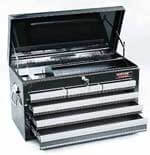 Even if you aren’t handy, there are everyday situations that require a hammer, a screwdriver, a tape measure, or a saw.
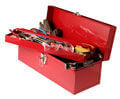 Contractor John Burke is a big fan of pry bars, and carries two or three different kinds. He also carries a small crowbar that provides the right amount of leverage for removing stubborn nails from lumber.
 The idea that comes to mind is that it will be a fantastic year if we can inspect another 3000 homes and do it without a single complaint! A lofty goal indeed, but one worth working towards!
 When people lack a well-articulated case for recommendations it has numerous risks. Customer confidence is reduced with an answers such as “be sure the inspector is licensed”, or my favorite from agents, “he has never killed a deal in my office”. As all should know, there is no license requirement in Florida for home inspectors (a subject for another column), and the deal killing statement is hardly customer-focused. A more compelling case might be something such as a description of our own Chris Brown, “Chris has been a state licensed contractor for over twenty years, an ASHI certified home inspector since 1997 and has performed more than 3,000 home inspections. I would recommend Chris to my mother”. Now THAT is compelling!
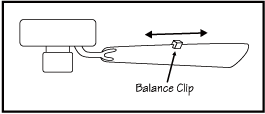 When properly installed and balanced, a ceiling fan should not wobble excessively. Make sure your fan has been mounted properly; there should be an electric box or special bracing to support the fan’s weight and movement. See Figure to the right..
 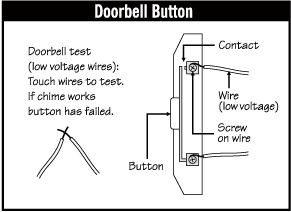 If the wires look okay, disconnect their ends and touch them together to complete the circuit. If the doorbell rings now, you have found the problem—a bad button. You can easily replace the button with a matching button from the hardware store.
 Almost every sliding patio screen door in the world sticks, because few homeowners know they can adjust the rollers that run in the track. You still need to keep the track clean, but adjusting the rollers is the key.
 You can also use a special paint that resists mildew and peeling. First, kill existing mildew with laundry bleach and water. Scrape away any loose paint, and sand the surfaces smooth. Spackle as needed. Then paint with Zinsser brand Perma-White Bathroom Wall and Ceiling Paint. This is a self-priming paint, so apply two coats. See Figure to the left.
 Remember that most natural fireplaces are heat losers when operated in cold weather. Most of the heat goes up the chimney. Fireplaces do work well at removing excessive moisture levels in the winter because they draw lots of air into your home for ventilation (provided a window is open!)
 It’s a good idea to test this emergency release before you need it, just to make sure it works properly. If you are confused by the procedure even after reading the following instructions, have someone show you how the release operates.
 Find a circular lock at the top panel of the garage door, near the center, where the door connects to the operator track. See Figure to the right. Open this lock and pull the attached cable through the opening. The cable attaches to the release that detaches the opener. You can now open the door manually.